Review - 'The Stolen Queen' by Fiona Davis


You dangle ancient Egyptian curses in front of me, and I'm going to sign up every time. But I feel like The Stolen Queen wasn't quite what I was expecting.

At its core, this is more of a found family and coming-of-age story than anything else. Its characters were its strongest component, and it was satisfying to follow Charlotte through her archeological journey and Annie through her Met Gala adventures while seeing them gain confidence and grow into themselves.

Another thing the story got right was the atmosphere, from the dusty ancient archeological sites to the hushed reverence of the Met to the glamour and excitement of its party of the year. It makes you feel like you are really there.

While the story did keep me engaged throughout, I wouldn't say it was unputdownable at any point. The dual timeline is really more of a triple narrative, with Charlotte and Annie both in the present and Charlotte also in the past. That means anytime we build up momentum, we immediately switch to a different scene, which has the effect of slowing the pacing down.

Of course the Egyptian slant with its ancient history and antiquities and curses is what really drew me to this story in the first place. But before you get too excited, you should know there are no actual paranormal events in here. This takes place solidly in our physical world, and so all mysteries are precipitated by human actions.

If I were to point to one thing that fell short for me in here, it's that everything comes across just a smidge too superficial and wrap up a bit too nicely. There is this persistent feeling that nothing is on the line, that everything will work out for everyone. And because of that, it lacks the all-important tension that really propels a story forward and keeps the reader glued to the pages.

Nevertheless, I think historical fiction fans will find this enjoyable, and the ancient Egyptian angle certainly adds a compelling note to the whole thing. Just make sure you set expectations correctly going in that this is really more cozy than thrilling.

Readaroo Rating: 3.5 stars

Review - 'The Three Lives of Cate Kay' by Kate Fagan


You know what, ironically, makes readers care about who has written the book? A pseudonym.

Hmm really? Cause that's not been my experience.

If you know me, you know my usual complaint with books is that they have intriguing premise and lackluster execution. But in this case, we have the opposite problem. The Three Lives of Cate Kay's weak premise makes it hard for the story to go anywhere. And so in order for interesting things to happen, we're forced to watch characters behave in artificial and forced ways, all in the service of having a story at all.

To my absolute consternation, the dreaded miscommunication trope runs amok in here. Every time I see it in a book, I can feel my eyeballs roll to the back of my head. But this story really takes it to town with its liberal and quite frankly, shameless usage. The entire plotline hinges on these pointless misunderstandings that could easily be cleared up, if only the characters behaved in ways that actually made sense.

But really, all the interactions were a little bit off. Everyone was obsessed with the main character, latching onto her the moment they meet her and fighting for her attention. She comes off the pages as pedestrian and even a bit unlikable at times, yet the story makes her out to be super special. The other points of view don't feel genuine either, too polished and into Cate Kay to really be authentic.

There were so many moments sold as insightful or momentous, yet it all felt like much ado about nothing. Like we'd be told how readers really care who the author is behind a book, but do they? Or how profound "cosmic bigness" is, but okaaay? Or what a clever name Cate Kay is, but I keep mispronouncing it as Cat Kay in my head? (That last one might be just me.)

Even the book within a book didn't match its lofty promise. Here is a supposedly bestselling book, one in which the world is in such a frenzy over that everyone is dying to find out who the author is behind the pseudonym. Yet every passage quoted is so drab and dull, I find it hard to believe this could've caught any reader's attention, let alone the entire world.

So it's all these seemingly little things, sprinkled in everywhere, that add up to make me feel unable to buy into this story. There is a cognitive dissonance here that always reminds me what I'm reading isn't real, that these characters are fake. And at the end of the day, when you're talking about a fictional memoir, the characters are the only thing that really matter. If I can't connect with them, then I just can't connect with the story.

Readaroo Rating: 2.5 stars

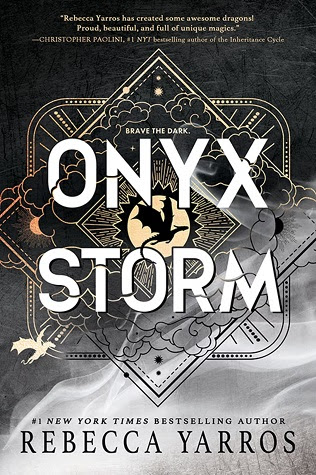
Review - 'Onyx Storm' by Rebecca Yarros


Can you really fill 500 pages with nothing but posturing and dithering, and call it a book? Apparently you can.

What the heck happened here? Was Rebecca Yarros kidnapped and an imposter wrote this book? Did she crack under the pressure and had to ChatGPT it? Because this doesn't resemble at all the series I've come to know and love, and I'm left pretty speechless (well, not so speechless that I can't rant).

Let's start by asking the most crucial question of all: did anything of consequence actually happen in this book? And the answer is unfortunately no. No plot was furthered, no stakes were raised. In fact, the end of the book is where I thought it would begin, so you can imagine my bewilderment at all the pages in between.

So what were these hundreds of pages filled with? Endless scenes of Violet and Xaden declaring how much they love each other (yeah, we get it) while throwing a fit at anyone who dare disagree (wah wah), interspersed with political intrigue that didn't amount to anything (who are these randos?) and quests that didn't amount to anything either (who even cares).

Where is the tension of the first book? Where are the jaw-dropping reveals of the second? But what the third book lacks from the first two, it amply made up by being inexplicably confusing. There were so many needless characters and locations mentioned, none of which really mattered. I kept flipping back and forth to the map, trying and failing to discern what it is I'm meant to take away from those moments.

Every scene in the first book felt essential and memorable, and the same could be said for the second book (minus the ones related to Violet and Xaden's mind-numbing conflicts). And yet, I come to a close on the third book and can hardly point to even one thing in here that stood out. Honestly, I barely remember what happened because nothing actually did.

And in place of real developments, we get non-reveals disguised under intentionally obscure writing. Instead of calling something or someone by its name, we get treated to vague pronouns like "it", "he", and "she", only for the subject to be divulged many pages later once the reader is good and befuddled. And each time this happened, it was treated like a reveal, as if we readers are too dumb to notice we've been had.

Violet and Xaden's interactions border on insufferable in here. What made their relationship compelling in the first book was the intrigue of enemies-to-lovers. That quickly started wearing thin in the second book, and by the time we get to this one, all the shine had fallen off. The trope is over and done with two books ago, so why is Yarros still harping on it? After all, there's a reason why lovers-who-can't-stand-to-be-apart isn't a trope, and it's because no one wants to read that whiny crap.

Just to cement how far this has deviated from the series I love, we only need to look at the end of this book. What I expected was to be wowed by a supremely shocking development on the fantasy side, something to tide me over for the next however many years it will take Yarros to write the next book. Instead, we get a trivial update on Violet and Xaden's relationship, presented as if it's the sort of epiphany that will keep me coming back for book 4. No, thanks.

At one point while trudging through this, I started to doubt myself and my love for the series, wondering if I'd imagined the whole thing and was just caught up in the hype. Then in a moment of confusion, I went to look something up in the first book and was immediately and thoroughly sucked in, only managing to tear myself away two hours later. Reading them side by side, the difference in the quality and immersiveness of the two books is stark and dispiriting. And when I would rather reread a book I'd already read in the series than the shiny new installment, you know something is terribly wrong.

Which brings us to the question of why does this book even exist in the first place. Did Yarros think this was an essential tale that needed to be told, but it somehow went off the rails during the writing process? Did she take inspiration from Peter Jackson and The Hobbit and try to squeeze as many books as possible out of the smallest amount of content? Or did she get talked into a five-parter by her publishing team against her better judgement? Whatever the reason, I can't help but think this book is such a poor showing, surely many of her readers will not continue from here.

It isn't just that this book is filler. It's that it's such trite, garbled, confused filler as to make me lose confidence in the author and her ability to deliver the rest of the series. This book not only reeks of confusion for the reader, but it also seems like Yarros herself is confused too, as if even she doesn't know where her series is going. And that is disheartening indeed.

When I first started this series, I went in with some trepidation. Rebecca Yarros comes from a romance background, so I thought there was a chance she wouldn't be able to balance fantasy and romance in the same story. I was afraid that she would prioritize the romance to the detriment of the fantasy, and three books in, my worst fears are realized. Maybe her original fanbase is thrilled by this book, but as a reader who got hooked on Fourth Wing primarily because of its fantasy badassery—dragons, signets, heroes and heroines, you name it—this book doesn't deliver any of what I wanted.

Readaroo Rating: 2 stars

Review - 'Below Zero' by Ali Hazelwood


I feel like to really enjoy Ali Hazelwood and her brand of romance, you have to be someone who loves nerdy science talk and wacky banter, the more the better and preferably all in the same sentence. Lucky for me, that's exactly the sort of thing I enjoy.

Let's start with the science here. Hannah and Ian both work for NASA on engineering teams that land rovers on Mars. Yeah, I pretty much hyperventilated when I realized that was the setting of their romance. It harkens back to my youth when I dreamed of working for NASA, so you can understand my excitement. Then you add in the copious amounts of technical jargon that Hazelwood always sprinkles into her stories and my space-loving heart was just blown into smithereens.

Of course as always, the dialogue was on point and had me in stitches from beginning to end. It's not just the conversation between our two mains. It's also all the side chatter and even the inner dialogue. Everything felt so sharp and witty and thoroughly delightful.

One thing is that Hazelwood's stories do tend to rely excessively on the miscommunication trope. So it's with relief that I report the conflicts in here actually make sense and it's not just two people deciding not to say simple things to each other. And since it's a novella, the conflicts don't drag on and on, but rather is resolved swiftly and with satisfaction.

I loved this story so much! I only wish Hazelwood had saved the premise for a full-length novel instead so I could've had more of it.

Readaroo Rating: 4.5 stars

Review - 'Cross My Heart' by Megan Collins


I don't think I've read a domestic thriller this fun since Gone Girl. And I'll tell you why.

Domestic thrillers are hard to write. Usually, there's only two relevant characters, the guy and the gal. One of them did it (whatever "it" is). Is it him? Is it her? Or is it some crazy combination of them both? And once you've read a few, you kind of have the genre figured out and it starts to feel rather repetitive. So it's rare for a story that utilizes this technique to grab me. And this one did.

We have the gal, Rosie, who is desperate to find her soulmate, so desperate in fact that she's coming across as a little bit unhinged. When her bum heart is replaced by the heart of a dead woman, she sees the opportunity to make all her dreams come true. Now enters the guy. For wouldn't it just be fate if she could capture the love of the man whose dead wife's heart now beats in her chest? It sure would, as long as he is the dream man she thinks he is.

I was sucked in from the very first page. Every moment felt essential and interesting, there to entertain me and keep me guessing. Just when I think I've got it figured out, another revelation had me gasping and reconfiguring the puzzle pieces in my head.

But this is a book of two halves, for what starts out as a domestic thriller doesn't remain that way. About halfway through, it morphs into the most interesting of mysteries. Not only did the twist there take me by surprise, but so did the slight genre shift. It feels like a gutsy move, to start a book as one kind of thriller and end it on a different one.

None of the characters were truly likable, yet they were all intriguing. I cared about them and I wanted to know more even though they were all shades of crazy. You know, there's a fine line between kooky characters you want more of versus those you just don't care about. And this book got it exactly right.

I mean, could the events in this book actually happen in real life? Um, I sure hope not. Do you need to suspend all disbelief to read this? Yeah, absolutely. But if you can, I guarantee you'll be in for a very good time.

Readaroo Rating: 4 stars

Review - 'One Dark Window' by Rachel Gillig


Did we all read the same book? Because this was... not good.

In general, I feel like fantasy is a genre I can rely on. Give me an interesting premise, a half-decent execution, some badass heroes and heroines, and I'm pleased as punch. And yet, here comes One Dark Window, making me rethink my entire love for this genre. Because I'm hard pressed to point to even one thing that I truly enjoyed in here.

Let's start with our characters. Wow, were they dumb. Elspeth could barely do anything without first being told, whether it's to be quiet or to run. She and her merry band of allies make one misstep after another, including rushing into battles they shouldn't and distracting each other during crucial moments. I have a hard time believing these characters could even function, let alone save the kingdom.

Neither were they likable, especially our heroine. Elspeth is about the weakest protagonist to have ever graced a fantasy. She gets so easily offended at everything, hates every person she sees, and is constantly tearing up from hurt feelings. Boo hoo. She also seems unable to eat, losing her appetite at every meal, poor thing. But perhaps I'm too quick to judge, and what I attribute to her unlikable personality is simply because she is hangry?

The supporting characters aren't much better, and together, there is this feeling that it's a group of idiots just trampling around getting themselves into trouble. But not to worry, because the villains aren't any smarter either. At one point, one of our good guys gets into an argument with one of the bad guys, and—no joke, you guys—the argument was decided by glaring. Like the one who glared harder and longer was the victor and the other was forced to lower his gaze in shame.

Or another of my favorite scenes—one of our villains forces our merry band to play a game where everyone is compelled by magic to tell the truth, and each can have a turn asking a question of every other person. Ah, I could feel the tension in the air, for here's the moment when the truth will be revealed. And then comes the questions—who wants to marry who, who is better looking, who loves who. I tell you, I shriveled up and died a little on the inside.

The worldbuilding feels both so detailed that you suffer from information overload (why so many cards and characters?), but also not sharp enough that you really feel immersed in the universe. The way information is parsed out, one teeny tiny bit at a time, is to maximize the reveals later on, so you're often confused for no good reason in the meantime. And when the reveals finally do happen, they weren't even that surprising.

Of course, this wouldn't be a romantasy without the requisite romance and the one in here is about as bland as they come. Why were Elspeth and Ravyn attracted to each other? The book certainly doesn't make it clear. And not only that, but when they do finally come together, there is quite the ick factor because of The Nightmare in her head, watching the whole thing. Eww!

You know the scene that really cemented my disillusionment with this book though? When a character was cold (not magically cold, mind you, just cold from being outside for too long), and one of our idiots used a Scythe card to warm them up. Never mind that using magic costs the wielder irreparable damage. That I can look overlook. What I can't overlook is that the Scythe card doesn't work that way. It changes someone's emotions, not what they actually are (as the book had already explained at length). So instead of actually warming up the poor dope, they just made them think they feel warmer.

I have to draw the line somewhere, and when the magic system is written so wishy washy and without sharpness that even the author got herself confused, that's when I finally realized this book isn't going to cut it

Now, if you're wondering if you should give this a go, I suggest you read the version that everyone else read and definitely not the one that I did. Good luck.

Readaroo Rating: 2 stars

Review - 'Rental House' by Weike Wang


I found the first half to be as sharp and piercing as they come, but then the second half kind of lost me.

We start off with Keru and Nate each taking a turn inviting their parents to vacation with them. Keru's Chinese parents are strict and emotionally guarded, while Nate's white, working-class parents don't quite know what to make of their son's career in academia. So when you throw these characters together, surely comedy and conflict ensues.

And it does. That first part definitely had me chuckling and shaking my head, with its sharp, satirical commentary of the typical dynamics within a Chinese American family and a white working-class family. Add to that the factor of marrying outside of your race and class, and each scene felt like such a zinger. The frequent misunderstandings and earnest hurt feelings made for a searing and funny read.

But I'm not sure I was as enamored with the second part of the book. At times, it became too exaggerated and I had a hard time relating to the characters and their inflexible ways. It feels like in Part Two, they became caricature of the people they were in Part One, ever more obstinate and set in their ways. I saw less and less of the humor I had previously enjoyed, and I just felt sad for the characters.

This isn't that long of a read. It honestly feels a bit like one of those stories where the author came up with a specific situation and wrote a novel around it. As a result, that original premise of vacationing with the parents shines as the story's strongest part. The rest of it did feel less focused, as if it were there to pad a great scene out into a full-length novel.

But don't let me dissuade you. I feel like this is my usual complaint with literary fiction, that I always expect more than it gives me. I hope to walk away with food for thought, but instead, the rather directionless culminations always leave me more befuddled than enlightened.

Readaroo Rating: 3 stars

Labels

A.M. Stuart A.R. Torre Adam Higginbotham Agatha Christie Alex Finlay Alex Michaelides Ali Hazelwood Amor Towles Ana Huang Ann Patchett Anthony Horowitz Ashley Elston beach read Becky Chambers Blake Crouch bubblegum horror Carley Fortune Catriona Ward Chinese Christina Lauren classics Colleen Hoover contemporary cozy cozy fantasy DNF domestic drama domestic suspense domestic thriller Elin Hilderbrand Elle Cosimano Emily Henry erotica Evie Dunmore fairytale retelling fanfiction fantasy favorite series favorites Gillian McAllister Greek mythology hard sci-fi Helen Hoang Helene Tursten Hercule Poirot historical fiction historical romance Holly Black Holly Jackson horror humor Jane Austen Jason Rekulak Jeffrey Kluger Jennifer Hillier Jennifer Saint Jesse Q. Sutanto John Marrs Josie Silver Katee Robert Katherine Arden Kevin Kwan Kristen Ciccarelli Liane Moriarty Lisa Jewell literary fiction Liu Cixin Liz Moore Loreth Anne White Lucy Foley Madeline Miller magical realism Marcus Kliewer Mason Coile memoir Min Jin Lee Miss Marple mystery mystery/thriller Naomi Novik new adult nonfiction novella Peter Swanson Pierce Brown psychological horror psychological thriller R.F. Kuang Rachel Hawkins Rebecca Ross Rebecca Serle Rebecca Yarros Richard Osman Robert Jackson Bennett rom-com romance romantasy romantic suspense Rufi Thorpe Sally Hepworth Samantha Downing sci-fi science Shari Lapena Sherry Thomas Simone St. James social satire space space program speculative fiction Stephen King Stuart Turton T.J. Klune Taylor Jenkins Reid Tessa Bailey thriller translation Uketsu V.E. Schwab women's fiction YA YA fantasy Yangsze Choo
Powered by Blogger.